cryptocurrency

Cryptocurrency

The most popular wallets for cryptocurrency include both hot and cold wallets. Cryptocurrency wallets vary from hot wallets and cold wallets. Hot wallets are able to be connected to the web, while cold wallets are used for keeping large amounts of coins outside of the internet https://gambling-sites-us.com/.

Aquí en CoinMarketCap, trabajamos muy duro para garantizar que toda la información relevante y actualizada sobre criptomonedas, monedas y ‘tokens’ se pueda ubicar en un lugar fácil de encontrar. Desde el primer día, el objetivo era que el sitio fuera el mejor lugar en línea para acceder a los datos del mercado de criptomonedas, y trabajamos arduamente para facultar a nuestros usuarios con nuestra información imparcial y precisa.

On October 31, 2008, Nakamoto published Bitcoin’s whitepaper, which described in detail how a peer-to-peer, online currency could be implemented. They proposed to use a decentralized ledger of transactions packaged in batches (called “blocks”) and secured by cryptographic algorithms — the whole system would later be dubbed “blockchain.”

Top cryptocurrency

Yes, you can access historical cryptocurrency market data via the /v1/global-metrics/quotes/historical API endpoint. This allows you to retrieve past global market metrics, such as market capitalization and Bitcoin dominance, based on specified time ranges and intervals.

bitcoin cryptocurrency

Yes, you can access historical cryptocurrency market data via the /v1/global-metrics/quotes/historical API endpoint. This allows you to retrieve past global market metrics, such as market capitalization and Bitcoin dominance, based on specified time ranges and intervals.

Blueprint has an advertiser disclosure policy. The opinions, analyses, reviews or recommendations expressed in this article are those of the Blueprint editorial staff alone. Blueprint adheres to strict editorial integrity standards. The information is accurate as of the publish date, but always check the provider’s website for the most current information.

The volatility of the cryptocurrency market presents opportunities to generate significant gains in a short time. But extreme volatility also makes the crypto market dangerous for inexperienced traders.

Crypto exchanges enforce these restrictions by using geofencing software, which uses IP addresses to determine a user’s location and limit access if they are in a high-risk jurisdiction. The unavailability of certain crypto exchanges in specific countries is due to regulatory restrictions and concerns about the potential misuse of cryptocurrencies for illicit activities, as well as the complexities and costs associated with complying with various regulatory frameworks.

This API is available on the following plans:• Basic• Hobbyist (1 month)• Startup (1 month)• Standard (3 months)• Professional (12 months)• Enterprise (Up to 6 years)Explore the plans and their features on the CoinMarketCap API pricing page.

Bitcoin cryptocurrency

Bitcoin debuted in 2009, when the software underpinning the currency was released. Its origins are a bit mysterious, however, and a person (or perhaps group) known as Satoshi Nakamoto claims the credit for unveiling the cryptocurrency.

We are an independent, advertising-supported comparison service. Our goal is to help you make smarter financial decisions by providing you with interactive tools and financial calculators, publishing original and objective content, by enabling you to conduct research and compare information for free – so that you can make financial decisions with confidence.

Not only is Bitcoin (BTC) the first cryptocurrency, but it’s also the best known of the more than 19,000 cryptocurrencies in existence today. Financial media eagerly covers each new dramatic high and stomach-churning decline, making Bitcoin an inescapable part of the landscape.

In the Web3 space, many consider such an organization necessary to innovate, and it’s hard to disagree. However, efficiency at the expense of decentralization goes against the cypherpunk ethos. This further increases the divide between Bitcoin and crypto.

Cryptocurrency regulation

In “Cryptocurrencies and Decentralized Finance,” published in the Spring 2022 Brookings Papers on Economic Activity, Igor Makarov of London School of Economics and Antoine Schoar of the MIT Sloan School of Management say that proliferation of finance applications built on blockchain technology could reduce the role of financial intermediaries and their profits. However, it could also reduce competition and pose significant challenges to regulators.

The SEC is already regulating the sector, demonstrated by its lengthy list of filings against crypto-centric businesses and projects, such as lawsuits and complaints against Ripple, Coinbase (COIN), Binance (BNB), and many others over their crypto products and services.

After an amendment to the PCMLTFA in 2019, exchanges in Canada are essentially regulated in the same way as money services businesses and are subject to the same due diligence and reporting obligations. In February 2020, the Virtual Currency Travel Rule came into effect in Canada, requiring all financial institutions and money services businesses (MSB) to keep a record of all cross-border cryptocurrency transactions (along with all electronic fund transfers).

Such transactions resemble peer-to-peer trading, when transactions are carried out directly between participants without the intermediaries. Such transactions are difficult to track, they are ideal for the regime of restrictions on cryptocurrency mining and trading and, of course, are in the “shadow” economy of the country.

This detailed guide will help you understand US cryptocurrency regulations environment and compliance needs. You’ll learn about the main regulatory bodies and the rules that affect cryptocurrency operations. The guide also shows you practical steps to stay compliant. Recent regulatory changes and their effects on US-based cryptocurrency businesses are also covered in detail.

Experience the Thrill of Mine Island Game APK: Play Casino Games in English!

Experience the Thrill of Mine Island Game APK: Play Casino Games in English!

Unleashing the Excitement of Mine Island Game APK: A Comprehensive Guide to Playing Casino Games in English

Unleashing the Excitement of Mine Island Game APK: A Comprehensive Guide to Playing Casino Games in English. Mine Island Game APK is a thrilling new addition to the world of casino games. In this guide, we will explore its key features, gameplay, and how to get started.
Firstly, it’s important to note that Mine Island Game APK is entirely in English, making it accessible to a wide audience. The game offers an immersive experience with high-quality graphics and realistic sound effects.
To start playing Mine Island Game APK, simply download the APK from a trusted source and install it on your device. Once you launch the game, you can create your account and start exploring the various casino games available.
Some of the popular games in Mine Island Game APK include slots, blackjack, roulette, and poker. Each game has its unique set of rules and strategies, and players can choose the one that suits their preferences.
Whether you’re a seasoned casino player or a newbie, Mine Island Game APK offers an exciting and engaging experience. With its user-friendly interface, generous bonuses, and exciting gameplay, it’s no wonder why this game is quickly becoming a favorite among casino enthusiasts.

Experience the Thrill of Mine Island Game APK: Play Casino Games in English!

Mine Island Game APK: Immerse Yourself in the World of English Casino Games

Mine Island Game APK offers an authentic English casino experience right at your fingertips. Play popular games such as Blackjack, Roulette, and Baccarat with stunning graphics and realistic sound effects. The game also provides a variety of slot machines, each with its own unique theme and bonus features. Mine Island Game APK is committed to fair play, using certified Random Number Generators to ensure that each game outcome is unbiased. Whether you are a seasoned casino player or a newcomer, Mine Island Game APK has something for everyone. So why not give it a try and immerse yourself in the world of English casino games today?

Experience the Thrill of Mine Island Game APK: Play Casino Games in English!

Experience the Thrill of Mine Island Game APK: A Must-Try for Casino Games Enthusiasts in English

Looking for a new and exciting casino game experience? Look no further than Mine Island Game APK. This must-try game for casino enthusiasts offers a thrilling and immersive gaming experience. Experience the rush of playing in a real casino right from your device. The stunning graphics and realistic sound effects will transport you to a virtual casino floor. With a wide variety of games to choose from, you’ll never get bored. Plus, the intuitive interface makes it easy for players of all skill levels to jump in and start playing. Don’t miss out on the chance to experience the thrill of Mine Island Game APK.

From Slots to Blackjack: Discover the Best Casino Games on Mine Island Game APK in English

From Slots to Blackjack, Mine Mine Island casino Island Game APK offers a wide variety of casino games for players to discover and enjoy. Dive into the vibrant world of Slots and try your luck on classic and video slot machines with various themes and jackpots. If you’re a fan of table games, take a seat at the Blackjack table and put your skills to the test. With realistic graphics, easy-to-use interface, and exciting rewards, Mine Island Game APK is the ultimate destination for casino enthusiasts. Don’t miss out on the chance to explore the best casino games on Mine Island Game APK and potentially hit the big time!

I had an amazing time playing Casino Games on the Mine Island Game APK, said Alex, a 28-year-old marketing specialist. The thrill of experiencing classic casino games in English was unmatched. The graphics and gameplay were smooth and easy to understand. I highly recommend this app to any casino game lover!

I was really disappointed with Mine Island Game APK, shared Sarah, a 35-year-old graphic designer. The concept of playing casino games in English is great, but the execution was poor. The game kept crashing and the customer support was non-existent. I wouldn’t recommend this app to anyone.

I was excited to try out Mine Island Game APK, expressed Mike, a 42-year-old businessman. The idea of playing casino games in English is a game-changer. Unfortunately, the experience was ruined by constant bugs and technical issues. I hope the developers fix these problems soon, as I would like to enjoy the thrill of playing casino games on this app.

Play Casino Games in English with Mine Island Game APK and Experience the Thrill!, said Emma, a 30-year-old teacher. I had a blast playing classic casino games with a modern twist. The app is user-friendly, the graphics are excellent, and the customer support is top-notch. I can’t get enough of Mine Island Game APK!

I was not impressed with Mine Island Game APK, said Tom, a 45-year-old engineer. The concept of playing casino games in English is interesting, but the execution lacked polish. The game was glitchy, and the customer support was slow to respond. I would pass on this app.

Want to experience the excitement of a casino from the comfort of your own home? Look no further than Mine Island Game APK! This app allows you to play a variety of casino games in English.

But what exactly is Mine Island Game APK and how do you play it? Our FAQ has got you covered.

From classic games like slots and blackjack, to more unique offerings like mine sweeper and fishing, there’s something for everyone on Mine Island.

So what are you waiting for? Download Mine Island Game APK today and start experiencing the thrill of the casino right at your fingertips.

cryptocurrency

Cryptocurrency

A stablecoin is a crypto asset that maintains a stable value regardless of market conditions. This is most commonly achieved by pegging the stablecoin to a specific fiat currency such as the US dollar https://gambling-us-games.com/. Stablecoins are useful because they can still be transacted on blockchain networks while avoiding the price volatility of “normal” cryptocurrencies such as Bitcoin and Ethereum. Outside of stablecoins, cryptocurrency prices can change rapidly, and it’s not uncommon to see the crypto market gain or lose more than 10% in a single day.

Cryptocurrency exchanges provide markets where cryptocurrencies are bought and sold 24/7. Depending on the exchange, cryptocurrencies can be traded against other cryptocurrencies (for example BTC/ETH) or against fiat currencies like USD or EUR (for example BTC/USD). On exchanges, traders submit orders that specify either the highest price at which they’re willing to buy the cryptocurrency, or the lowest price at which they’re willing to sell. These market dynamics ultimately determine the current price of any given cryptocurrency.

Cryptocurrency was invented by Satoshi Nakamoto, which is the pseudonym used by the inventor of Bitcoin. Even though digital currency concepts existed before Bitcoin, Satoshi Nakamoto was the first to create a peer-to-peer digital currency that reliably solved the issues facing previous digital money projects. Bitcoin was initially proposed in 2008 and launched in early 2009. Following the invention of Bitcoin, thousands of projects have attempted to imitate Bitcoin’s success or improve upon the original Bitcoin design by leveraging new technologies.

Cryptocurrency news

Republican Sen. Cynthia Lummis of Wyoming has proposed legislation mandating the U.S. government stockpile bitcoin, which advocates said would help diversify government holdings and hedge against financial risks. Critics say bitcoin’s volatility make it a poor choice as a reserve asset.

Creating such a stockpile would also be a “giant step in the direction of bitcoin becoming normalized, becoming legitimatized in the eyes of people who don’t yet see it as legitimate,” said Zack Shapiro, an attorney who is head of policy at the Bitcoin Policy Institute.

Once a skeptic who said a few years ago that bitcoin “ seems like a scam,” Trump has embraced digital currencies with a convert’s zeal. He’s launched a new cryptocurrency venture and vowed on the campaign trail to take steps early in his presidency to make the U.S. into the “crypto capital” of the world.

Trump also promised that as president he’ll ensure the U.S. government stockpiles bitcoin, much like it already does with gold. At the bitcoin conference earlier this summer, Trump said it the U.S. government would keep, rather than auction off, the billions of dollars in bitcoin it has seized through law enforcement actions.

The highly volatile nature of cryptocurrencies as well as their use by criminals, scammers and rogue nations, has attracted plenty of critics, who say the digital currencies have limited utility and often are just Ponzi schemes.

cryptocurrency

Cryptocurrency

Litecoin (LTC) was launched in 2011 by Charles Lee. Like Bitcoin, Litecoin employs the proof-of-work consensus mechanism. Though Litecoin is both faster and cheaper than Bitcoin, it has not been as widely adopted as Bitcoin and therefore has less value.

Jordan Kelley, founder of Robocoin, launched the first bitcoin ATM in the United States on 20 February 2014. The kiosk installed in Austin, Texas, is similar to bank ATMs but has scanners to read government-issued identification such as a driver’s license or a passport to confirm users’ identities.

According to PricewaterhouseCoopers, four of the 10 biggest proposed initial coin offerings have used Switzerland as a base, where they are frequently registered as non-profit foundations. The Swiss regulatory agency FINMA stated that it would take a “balanced approach” to ICO projects and would allow “legitimate innovators to navigate the regulatory landscape and so launch their projects in a way consistent with national laws protecting investors and the integrity of the financial system.” In response to numerous requests by industry representatives, a legislative ICO working group began to issue legal guidelines in 2018, which are intended to remove uncertainty from cryptocurrency offerings and to establish sustainable business practices.

Because they do not use third-party intermediaries, cryptocurrency transfers between two transacting parties can be faster than standard money transfers. Flash loans in decentralized finance are an excellent example of such decentralized transfers. These loans, which are processed without requiring collateral, can be executed within seconds and are mostly used in trading.

For Ethereum, transaction fees differ by computational complexity, bandwidth use, and storage needs, while bitcoin transaction fees differ by transaction size and whether the transaction uses SegWit. In February 2023, the median transaction fee for Ether corresponded to $2.2845, while for bitcoin it corresponded to $0.659.

Bitcoin is the most popular crypto to invest in. The ‘best’ cryptocurrency will depend on the market. During crypto bull markets, altcoins tend to outperform bitcoin. However, during bearish times, most altcoins underperform bitcoin.

cryptocurrency

Cryptocurrency

Bitcoin uses public-key cryptography, meaning that a wallet consists of two keys, one public and one private. Public keys identify wallets on the blockchain and are shared with other parties in order to receive BTC, while private keys enable you to access and send BTC from the wallet https://gambleonline-us.com/.

Bitcoin is based on revolutionary blockchain technology, where transactions are recorded on a public distributed ledger and are secured by a decentralized network of computers dedicating their computational power to solving cryptographic tasks.

In January 2024 the SEC approved 11 exchange traded funds to invest in Bitcoin. There were already a number of Bitcoin ETFs available in other countries, but this change allowed them to be available to retail investors in the United States. This opens the way for a much wider range of investors to be able to add some exposure to cryptocurrency in their portfolios.

The original reward of 50 BTC per mined block as of the genesis block has been halved several times to 25, 12.5, and, as of 11 May 2020, to 6.25 BTC. The Bitcoin protocol dictates that these Halvings take place every 210,000 blocks. Once the limit of 21 million BTC is reached, miners will no longer receive block rewards, but they will still receive transaction fees.

what is cryptocurrency

What is cryptocurrency

In 1983, American cryptographer David Chaum conceived of a type of cryptographic electronic money called ecash. Later, in 1995, he implemented it through Digicash, an early form of cryptographic electronic payments. Digicash required user software in order to withdraw notes from a bank and designate specific encrypted keys before they could be sent to a recipient. This allowed the digital currency to be untraceable by a third party.

Many, or all, of the products featured on this page are from our advertising partners who compensate us when you take certain actions on our website or click to take an action on their website. However, this does not influence our evaluations. Our opinions are our own. Here is a list of our partners and here’s how we make money.

In March 2021, South Korea implemented new legislation to strengthen their oversight of digital assets. This legislation requires all digital asset managers, providers and exchanges to be registered with the Korea Financial Intelligence Unit in order to operate in South Korea. Registering with this unit requires that all exchanges are certified by the Information Security Management System and that they ensure all customers have real name bank accounts. It also requires that the CEO and board members of the exchanges have not been convicted of any crimes and that the exchange holds sufficient levels of deposit insurance to cover losses arising from hacks.

cryptocurrency market

In 1983, American cryptographer David Chaum conceived of a type of cryptographic electronic money called ecash. Later, in 1995, he implemented it through Digicash, an early form of cryptographic electronic payments. Digicash required user software in order to withdraw notes from a bank and designate specific encrypted keys before they could be sent to a recipient. This allowed the digital currency to be untraceable by a third party.

Many, or all, of the products featured on this page are from our advertising partners who compensate us when you take certain actions on our website or click to take an action on their website. However, this does not influence our evaluations. Our opinions are our own. Here is a list of our partners and here’s how we make money.

Cryptocurrency market

CoinMarketCap no ofrece consejos financieros o de inversión sobre qué criptomoneda, token o activo representa una buena inversión o no, tampoco ofrece consejos sobre la elección del mejor momento para comprar o vender. Somos estrictamente una empresa de datos. Recuerda que los precios, los rendimientos y los valores de los activos financieros cambian. Esto significa que cualquier capital que puedas invertir está en riesgo. Recomendamos buscar la guía de un asesor de inversiones profesional para obtener orientación de acuerdo a tus circunstancias personales.

With a blockchain, it’s possible for participants from across the world to verify and agree on the current state of the ledger. Blockchain was invented by Satoshi Nakamoto for the purposes of Bitcoin. Other developers have expanded upon Satoshi Nakamoto’s idea and created new types of blockchains – in fact, blockchains also have several uses outside of cryptocurrencies.

Los NFT son imágenes de múltiples usos almacenadas en una blockchain. Pueden usarse como arte, una forma de compartir códigos QR, entradas y muchas cosas más. El primer uso destacado fue en el arte, con proyectos como CryptoPunks y Bored Ape Yacht Club ganando grandes seguidores. También listamos todas las colecciones de NFT más importantes disponibles. Recopilamos los últimos datos de ventas y transacciones, además de lanzamientos de colecciones de NFT próximos en cadena. Los NFT son una parte nueva e innovadora del ecosistema cripto que tiene el potencial de cambiar y actualizar muchos modelos de negocio para el mundo Web 3.

The circulating supply of a cryptocurrency is the amount of units that is currently available for use. Let’s use Bitcoin as an example. There is a rule in the Bitcoin code which says that only 21 million Bitcoins can ever be created. The circulating supply of Bitcoin started off at 0 but immediately started growing as new blocks were mined and new BTC coins were being created to reward the miners. Currently, there are around 19.81 million Bitcoins in existence, and this number will keep growing until the 21 millionth BTC is mined. Since 19.81 million BTC have been mined so far, we say that this is the circulating supply of Bitcoin.

cryptocurrency

Cryptocurrency

The Howey test is a U.S. legal principle for determining whether a financial arrangement qualifies as an investment contract and is subject to regulatory requirements. The Howey test has become a cornerstone in the SEC’s assessment of various financial instruments and arrangements, including cryptocurrencies and initial coin offerings (ICOs) https://gambleonline-us.com/.

These more aggressive sanctions and policing efforts directed at cryptocurrencies in the past year have occurred alongside a call for the United States to develop a central bank digital currency (CBDC). In the March 2022 executive order, President Biden called this out as a priority on par with cracking down on cryptocurrency-enabled cybercrimes, writing, “My Administration places the highest urgency on research and development efforts into the potential design and deployment options of a United States CBDC.” But the executive order also acknowledged that development of a U.S. CBDC was still at a relatively early stage and encouraged the Federal Reserve “to continue its ongoing CBDC research, experimentation, and evaluation” rather than committing to a specific timeline or implementation. Unlike cryptocurrencies, CBDCs are intended to be centralized, issued, and, in some cases, directly managed by central banks rather than public, decentralized blockchains. Given the backing of a central bank, CBDCs might compete more directly with stablecoins than other cryptocurrencies like Bitcoin that are not pegged to a reference asset. Ideally, CBDCs would offer some of the benefits of cryptocurrencies—fast transactions, innovation, financial inclusion—while also, like stablecoins, offsetting some of the risks, such as volatility, criminal activity, and energy-intensive mining.

The Financial Action Task Force (FATF) Travel Rule makes crypto exchanges share specific customer data for transactions above certain limits. This rule brings openness and helps stop illegal money activities in the crypto world.

What is cryptocurrency

As the first big Wall Street bank to embrace cryptocurrencies, Morgan Stanley announced on 17 March 2021 that they will be offering access to bitcoin funds for their wealthy clients through three funds which enable bitcoin ownership for investors with an aggressive risk tolerance. BNY Mellon on 11 February 2021 announced that it would begin offering cryptocurrency services to its clients.

The rewards paid to miners increase the supply of the cryptocurrency. By making sure that verifying transactions is a costly business, the integrity of the network can be preserved as long as benevolent nodes control a majority of computing power. The verification algorithm requires a lot of processing power, and thus electricity, in order to make verification costly enough to accurately validate the public blockchain. Not only do miners have to factor in the costs associated with expensive equipment necessary to stand a chance of solving a hash problem, they must further consider the significant amount of electrical power in search of the solution. Generally, the block rewards outweigh electricity and equipment costs, but this may not always be the case.

If you buy cryptocurrency, you have to store it. You can keep it on an exchange or in a digital wallet. While there are different kinds of wallets, each has its benefits, technical requirements, and security. As with exchanges, you should investigate your storage choices before investing.

The European Commission published a digital finance strategy in September 2020. This included a draft regulation on Markets in Crypto-Assets (MiCA), which aimed to provide a comprehensive regulatory framework for digital assets in the EU.

Because it is impossible to set up a central authority or bank to manage blockchains, crypto transactions are validated by nodes (computers connected to a blockchain). So the question is: How do these networks ensure that node operators are willing to partake in the validation process?

cryptocurrency market

Cryptocurrency market

Jede unserer Coin-Datenseiten verfügt über eine Grafik, welche sowohl aktuelle als auch vergangene Preisinformationen zu Coins und Tokens darstellt. Die Grafik illustriert die Entwicklung der Anlage ab Markteinführung. Man kann aber auch spezifische Zeiträume auswählen, um die Darstellung den eigenen Bedürfnissen anzupassen. Die Diagramme sowie die darin enthaltenen Informationen stehen Besuchern unserer Webseite gratis zur Verfügung. Die erfahrensten und professionellsten Händler entscheiden sich oft für die Nutzung der besten Krypto-API auf dem Markt. Unsere API ermöglicht Millionen von Aufrufen, um aktuelle Preise zu verfolgen und auch historische Preise zu untersuchen und wird von einigen der größten Krypto-Börsen und Finanzinstitutionen der Welt verwendet. CoinMarketCap bietet auch Daten über die erfolgreichsten Händler zur Überwachung an. Wir stellen auch Daten über die neuesten Trend-Kryptowährungen und trendige DEX-Paare bereit.

CoinCodex provides all the data you need to stay informed about cryptocurrencies. You can find cryptocurrency charts for more than 39431 coins, and access key data such as up-to-date prices, all-time high price, cryptocurrency market cap, trading volume and more. The crypto charts provided by CoinCodex are incredibly flexible – you can watch real-time prices or select between 8 pre-defined time frames, ranging from 24 hours to the entire price history of the coin. If you need more precision, you can select a custom date range. CoinCodex also gives you the ability to compare the price action of different cryptocurrencies on a single chart.

This API is available on the following plans:• Basic• Hobbyist (1 month)• Startup (1 month)• Standard (3 months)• Professional (12 months)• Enterprise (Up to 6 years)Explore the plans and their features on the CoinMarketCap API pricing page.

A coin is a cryptocurrency that is the native asset on its own blockchain. These cryptocurrencies are required to pay for transaction fees and basic operations on the blockchain. BTC (Bitcoin) and ETH (Ethereum) are examples of coins.

At the time of writing, we estimate that there are more than 2 million pairs being traded, made up of coins, tokens and projects in the global coin market. As mentioned above, we have a due diligence process that we apply to new coins before they are listed. This process controls how many of the cryptocurrencies from the global market are represented on our site.

With a blockchain, it’s possible for participants from across the world to verify and agree on the current state of the ledger. Blockchain was invented by Satoshi Nakamoto for the purposes of Bitcoin. Other developers have expanded upon Satoshi Nakamoto’s idea and created new types of blockchains – in fact, blockchains also have several uses outside of cryptocurrencies.

cryptocurrency prices

Cryptocurrency prices

“I see a lot of people listen to social media influencers (who) market crypto trading, attempting to make it look easy,” he said. “It is far from easy and requires great skill, time and dedication to become more advanced beem casino test.”

Tron’s transaction speed and low fees are major selling points for users. But the crypto has its controversies too. In March 2023, the SEC charged Tron founder Justin Sun with fraud and other securities law violations.

Hier bei CoinMarketCap arbeiten wir angestrengt daran, sicherzustellen, dass sämtliche relevanten und topaktuellen Informationen bezüglich Kryptowährungen, Coins und Tokens ganz einfach auf einen Blick einzusehen sind. Vom allerersten Tag an war es das Ziel der Seite, die “Nummer 1” der Online-Locations für Kryptomarkt-Daten zu sein. Wir bemühen uns sehr, unseren Usern durch unabhängige und korrekte Informationen die Möglichkeit zu geben, befähigte Entscheidungen zu treffen.

Cryptocurrency bitcoin price

Taproot is considered Bitcoin’s most significant upgrade in several years. It streamlines transaction processing, making it faster and more cost-efficient. Taproot went live on November 14, 2021, at block 709,632. It reduces the cost and data requirements for multi-signature transactions, making them more affordable. It also improves transaction privacy, making certain complex transactions, like Lightning Network transactions, appear indistinguishable from regular transactions.

cryptocurrency prices

Taproot is considered Bitcoin’s most significant upgrade in several years. It streamlines transaction processing, making it faster and more cost-efficient. Taproot went live on November 14, 2021, at block 709,632. It reduces the cost and data requirements for multi-signature transactions, making them more affordable. It also improves transaction privacy, making certain complex transactions, like Lightning Network transactions, appear indistinguishable from regular transactions.

4. Competition: The presence and performance of other cryptocurrencies also affect Bitcoin’s price. As more altcoins gain traction, some investment flows might shift away from Bitcoin, affecting its dominance and price.

The live price of Bitcoin is $102,810, with a total trading volume of $ 210.68M in the last 24 hours. The price of Bitcoin changed by -2.74% in the past day, and its USD value has increased by +3.41% over the last week. With a circulating supply of 19,813,850 BTC, the market cap of Bitcoin is currently 2.03T USD, marking a –% increase today. Bitcoin currently ranks #1 in market cap.

2. Market Sentiment: Positive news, such as Bitcoin ETF approvals or adoption by large institutions, can boost Bitcoin’s price and overall liquidity. Conversely, negative news or regulatory crackdowns can cause the BTC price to drop.

For mining pool, all you need to do is to join a mining group, and if that team solves a computational problem, blocks are added to the blockchain, they get the reward and you get a share of it based on your contribution.

Cryptocurrency prices

The first chain to launch smart contracts was Ethereum. A smart contract enables multiple scripts to engage with each other using clearly defined rules, to execute on tasks which can become a coded form of a contract. They have revolutionized the digital asset space because they have enabled decentralized exchanges, decentralized finance, ICOs, IDOs and much more. A huge proportion of the value created and stored in cryptocurrency is enabled by smart contracts.

Crypto prices are calculated by averaging cryptocurrency exchange rates on different cryptocurrency trading platforms. This way, we can determine an average price that reflects cryptocurrency market conditions as accurately as possible.

The Bitcoin market cap is currently 2,027.12 billion. We arrive at this figure by multiplying the price of 1 BTC and the circulating supply of Bitcoin. The Bitcoin price is currently $ 102,308 and its circulating supply is 19.81 million. If we multiply these two numbers, we arrive at a market cap of 2,027.12 billion.

Let’s say that a company creates Stablecoin X (SCX), which is designed to trade as closely to $1 as possible at all times. The company will hold USD reserves equal to the number of SCX tokens in circulation, and will provide users the option to redeem 1 SCX token for $1. If the price of SCX is lower than $1, demand for SCX will increase because traders will buy it and redeem it for a profit. This will drive the price of SCX back towards $1.

Cryptocurrency regulation

The CFTC supervises bitcoin derivatives and futures contracts. The CFTC classifies 14-year-old, extensively decentralized virtual currencies such as Bitcoin and Ether as “commodities” within its authority. Their jurisdiction is limited to combatting fraud and market manipulation in interstate trade.

Like the U.K., this island state classifies cryptocurrency as property but not legal tender. The Monetary Authority of Singapore (MAS) licenses and regulates exchanges as outlined in the Payment Services Act (PSA).

In October 2022, the lower house of the British Parliament recognized crypto assets as regulated financial instruments. The Financial Services and Markets bill became an act (law) in June of 2023 and extended existing laws regarding all crypto assets, services, and providers.

The SEC’s appeal in SEC v. Ripple Labs, Inc. follows a July 2023 ruling in the Southern District of New York that began when the SEC charged Ripple Labs, Inc. (Ripple) with conducting an unregistered securities offering through sales of its XRP token. The SEC argued that the offer and sale of XRP tokens constituted an offer and sale of investment contracts under SEC v. W.J. Howey, which provides that an “investment contract” is a contract, transaction, or scheme whereby a person: (1) “invests his money” (2) “in a common enterprise” and (3) “is led to expect profits solely from the efforts of the promoter or a third party.”4 In response, Ripple advanced an “essential ingredients test,” arguing that in addition to the three-part Howey test, investment contracts must also contain “essential ingredients”: (1) “a contract between a promoter and an investor that establishe the investor’s rights as to an investment,” which contract (2) “impose post-sale obligations on the promoter to take specific actions for the investor’s benefit” and (3) “grant the investor a right to share in profits from the promoter’s efforts to generate a return on the use of investor funds.”5

Both emerging-market and advanced economies still lag on comprehensive regulation and oversight. Only 19 of the 60 countries studied have regulations for taxation, AML/CFT, consumer protection, and licensing. 13% of the emerging market countries studied have all the above regulations.

cryptocurrency

Cryptocurrency

Rae Hartley Beck first started writing about personal finance in 2011 with a regular column in her college newspaper as a staff writer. Since then she has become a leader in the Financial Independence, Retire Early (FIRE) movement and has over 300 bylines in prominent publications including Money, Bankrate and Investopedia on all things personal finance https://us-gambling-near-you.com/. A former award-winning claims specialist with the Social Security Administration, Rae continues to share her expert insider knowledge with Forbes Advisor readers.

Price volatility has long been one of the features of the cryptocurrency market. When asset prices move quickly in either direction and the market itself is relatively thin, it can sometimes be difficult to conduct transactions as might be needed. To overcome this problem, a new type of cryptocurrency tied in value to existing currencies — ranging from the U.S. dollar, other fiats or even other cryptocurrencies — arose. These new cryptocurrency are known as stablecoins, and they can be used for a multitude of purposes due to their stability.

While some cryptocurrencies have seen massive gains in the past, predicting what coin might pull a 1000x return is impossible. For a digital asset to pull this kind of gain, it would have to be a very small, high-risk project. Investors should thoroughly research any cryptocurrency, understand the risks, and never invest more than they can afford to lose.

When covering investment and personal finance stories, we aim to inform our readers rather than recommend specific financial product or asset classes. While we may highlight certain positives of a financial product or asset class, there is no guarantee that readers will benefit from the product or investment approach and may, in fact, make a loss if they acquire the product or adopt the approach.

Cryptocurrency is a form of currency that exists solely in digital form. Cryptocurrency can be used to pay for purchases online without going through an intermediary, such as a bank, or it can be held as an investment.

Bitcoin cryptocurrency

Other economists, investors, and the central bank of Estonia have described bitcoin as a potential Ponzi scheme. Legal scholar Eric Posner disagrees, however, as “a real Ponzi scheme takes fraud; bitcoin, by contrast, seems more like a collective delusion”. A 2014 World Bank report also concluded that bitcoin was not a deliberate Ponzi scheme.

The supply of bitcoins is limited to 21 million, a feature that is hard-coded into the bitcoin protocol. This scarcity is designed to ensure bitcoin is a deflationary asset, giving it some similarities to scarce commodities like gold. Unlike fiat currencies, which can be printed at will, bitcoin’s fixed supply ensures that its holders cannot be diluted by individuals or cabals issuing more monetary units.

Not only is Bitcoin (BTC) the first cryptocurrency, but it’s also the best known of the more than 19,000 cryptocurrencies in existence today. Financial media eagerly covers each new dramatic high and stomach-churning decline, making Bitcoin an inescapable part of the landscape.

cryptocurrency regulation

Other economists, investors, and the central bank of Estonia have described bitcoin as a potential Ponzi scheme. Legal scholar Eric Posner disagrees, however, as “a real Ponzi scheme takes fraud; bitcoin, by contrast, seems more like a collective delusion”. A 2014 World Bank report also concluded that bitcoin was not a deliberate Ponzi scheme.

The supply of bitcoins is limited to 21 million, a feature that is hard-coded into the bitcoin protocol. This scarcity is designed to ensure bitcoin is a deflationary asset, giving it some similarities to scarce commodities like gold. Unlike fiat currencies, which can be printed at will, bitcoin’s fixed supply ensures that its holders cannot be diluted by individuals or cabals issuing more monetary units.

Cryptocurrency regulation

The SEC’s appeal in SEC v. Ripple Labs, Inc. follows a July 2023 ruling in the Southern District of New York that began when the SEC charged Ripple Labs, Inc. (Ripple) with conducting an unregistered securities offering through sales of its XRP token. The SEC argued that the offer and sale of XRP tokens constituted an offer and sale of investment contracts under SEC v. W.J. Howey, which provides that an “investment contract” is a contract, transaction, or scheme whereby a person: (1) “invests his money” (2) “in a common enterprise” and (3) “is led to expect profits solely from the efforts of the promoter or a third party.”4 In response, Ripple advanced an “essential ingredients test,” arguing that in addition to the three-part Howey test, investment contracts must also contain “essential ingredients”: (1) “a contract between a promoter and an investor that establishe the investor’s rights as to an investment,” which contract (2) “impose post-sale obligations on the promoter to take specific actions for the investor’s benefit” and (3) “grant the investor a right to share in profits from the promoter’s efforts to generate a return on the use of investor funds.”5

The district court, in its July 2023 ruling, rejected Ripple’s novel “essential ingredients” test, noting that “in the more than seventy-five years of securities law jurisprudence after Howey, courts have found the existence of an investment contract even in the absence of Defendants’ ‘essential ingredients,’ including in recent digital asset cases in this District.”6 Nevertheless, the district court found that, while Ripple’s institutional sales violated securities laws, the company’s programmatic sales (sales of XRP on digital asset exchanges) and other distributions (such as employee compensation and third-party development incentives) did not constitute securities offerings — marking the first major setback to the SEC’s digital asset enforcement initiative.7 Crucially, the district court distinguished between XRP sales based on their economic reality: institutional sales to sophisticated buyers under written contracts were deemed securities transactions because buyers reasonably expected profits from Ripple’s efforts, while programmatic sales on exchanges were not because buyers could not know they were purchasing from Ripple. The court also found that other distributions failed to meet the basic requirements of an “investment of money” since recipients did not provide payment to Ripple.

The South Carolina Attorney General’s Money Services Division stated in a 2018 interpretive letter that “ virtual currencies lack the characteristics of mediums of exchange. Therefore, it is the view of the Division that virtual currencies alone do not qualify as monetary value. However, to the extent that virtual currency transactions also involve the transfer of fiat currency, they may be subject to money transmission regulations under the Act.” The same letter stated that “ activities as they relate to virtual currencies do not require a license under the Act.” The Attorney General stated in Administrative Order Number MSD-19003 that “When an ATM does not act as a third party, and only facilitates a sale or purchase of virtual currency by the ATM operator directly with the customer…no license is required under the Act.” However, “ The exchange of virtual currency for fiat currency through an ATM that acts as a third party exchanger that facilitates contemporaneous exchanges of virtual currency for fiat currency…is money transmission and requires a license under the Act.” The South Carolina Attorney General’s Money Services Division has posted further guidance on their Money Services FAQs page.

cryptocurrency market

The SEC’s appeal in SEC v. Ripple Labs, Inc. follows a July 2023 ruling in the Southern District of New York that began when the SEC charged Ripple Labs, Inc. (Ripple) with conducting an unregistered securities offering through sales of its XRP token. The SEC argued that the offer and sale of XRP tokens constituted an offer and sale of investment contracts under SEC v. W.J. Howey, which provides that an “investment contract” is a contract, transaction, or scheme whereby a person: (1) “invests his money” (2) “in a common enterprise” and (3) “is led to expect profits solely from the efforts of the promoter or a third party.”4 In response, Ripple advanced an “essential ingredients test,” arguing that in addition to the three-part Howey test, investment contracts must also contain “essential ingredients”: (1) “a contract between a promoter and an investor that establishe the investor’s rights as to an investment,” which contract (2) “impose post-sale obligations on the promoter to take specific actions for the investor’s benefit” and (3) “grant the investor a right to share in profits from the promoter’s efforts to generate a return on the use of investor funds.”5

The district court, in its July 2023 ruling, rejected Ripple’s novel “essential ingredients” test, noting that “in the more than seventy-five years of securities law jurisprudence after Howey, courts have found the existence of an investment contract even in the absence of Defendants’ ‘essential ingredients,’ including in recent digital asset cases in this District.”6 Nevertheless, the district court found that, while Ripple’s institutional sales violated securities laws, the company’s programmatic sales (sales of XRP on digital asset exchanges) and other distributions (such as employee compensation and third-party development incentives) did not constitute securities offerings — marking the first major setback to the SEC’s digital asset enforcement initiative.7 Crucially, the district court distinguished between XRP sales based on their economic reality: institutional sales to sophisticated buyers under written contracts were deemed securities transactions because buyers reasonably expected profits from Ripple’s efforts, while programmatic sales on exchanges were not because buyers could not know they were purchasing from Ripple. The court also found that other distributions failed to meet the basic requirements of an “investment of money” since recipients did not provide payment to Ripple.

The South Carolina Attorney General’s Money Services Division stated in a 2018 interpretive letter that “ virtual currencies lack the characteristics of mediums of exchange. Therefore, it is the view of the Division that virtual currencies alone do not qualify as monetary value. However, to the extent that virtual currency transactions also involve the transfer of fiat currency, they may be subject to money transmission regulations under the Act.” The same letter stated that “ activities as they relate to virtual currencies do not require a license under the Act.” The Attorney General stated in Administrative Order Number MSD-19003 that “When an ATM does not act as a third party, and only facilitates a sale or purchase of virtual currency by the ATM operator directly with the customer…no license is required under the Act.” However, “ The exchange of virtual currency for fiat currency through an ATM that acts as a third party exchanger that facilitates contemporaneous exchanges of virtual currency for fiat currency…is money transmission and requires a license under the Act.” The South Carolina Attorney General’s Money Services Division has posted further guidance on their Money Services FAQs page.

cryptocurrency market

Cryptocurrency market

Yes, you can access live global cryptocurrency market data via the CoinMarketCap API, which provides real-time metrics like total market capitalization, Bitcoin dominance, and 24-hour trading volume snai casino review. You can use the /v1/global-metrics/quotes/latest API endpoint to retrieve this data.

Successful crypto trading requires an understanding of not only the markets but also the legal and regulatory environment. Cryptocurrency exchanges in the United States are subject to a range of geographic and regulatory limitations. For example, exchanges operating in New York State are classified as money transmission services and are required to obtain the BitLicense in order to operate.

Beyond trading, staking and lending services offer another avenue for crypto enthusiasts to generate passive income from their holdings. Staking involves holding and locking up cryptocurrency in a wallet to support the operations of a blockchain network, thereby receiving rewards for participating in the network’s consensus mechanism. On the other hand, cryptocurrency lending enables individuals to lend out their holdings to borrowers and receive interest payments.

Cryptocurrency

Various studies have found that crypto-trading is rife with wash trading. Wash trading is a process, illegal in some jurisdictions, involving buyers and sellers being the same person or group, and may be used to manipulate the price of a cryptocurrency or inflate volume artificially. Exchanges with higher volumes can demand higher premiums from token issuers. A study from 2019 concluded that up to 80% of trades on unregulated cryptocurrency exchanges could be wash trades. A 2019 report by Bitwise Asset Management claimed that 95% of all bitcoin trading volume reported on major website CoinMarketCap had been artificially generated, and of 81 exchanges studied, only 10 provided legitimate volume figures.

CoinMarketCap does not offer financial or investment advice about which cryptocurrency, token or asset does or does not make a good investment, nor do we offer advice about the timing of purchases or sales. We are strictly a data company. Please remember that the prices, yields and values of financial assets change. This means that any capital you may invest is at risk. We recommend seeking the advice of a professional investment advisor for guidance related to your personal circumstances.

Jordan Kelley, founder of Robocoin, launched the first bitcoin ATM in the United States on 20 February 2014. The kiosk installed in Austin, Texas, is similar to bank ATMs but has scanners to read government-issued identification such as a driver’s license or a passport to confirm users’ identities.

It can take a lot of work to comb through a prospectus; the more detail it has, the better your chances it’s legitimate. But even legitimacy doesn’t mean the currency will succeed. That’s an entirely separate question, and that requires a lot of market savvy. Be sure to consider how to protect yourself from fraudsters who see cryptocurrencies as an opportunity to bilk investors.

HODL is a cryptocurrency slang term that refers to holding a crypto coin or token for the long term. It comes from a typo in a 2013 thread titled “I AM HODLING” posted on BitcoinTalk, a cryptocurrency forum.

cryptocurrency regulation

Cryptocurrency regulation

Delaware has no cryptocurrency-specific laws, but cryptocurrency may be encompassed in existing money transmission statutes. 5 DE Code § 2303 states that “No person…shall…engage in the business of receiving money for transmission or transmitting the same without having first obtained a license hereunder.” However, money transmission is not defined in Delaware law. Major cryptocurrency exchanges Coinbase, Binance, and Gemini have all registered as money transmitters in Delaware.

Arkansas has no cryptocurrency-specific laws, but cryptocurrency may be encompassed in existing money transmission statutes. AR Code § 23-55-102 defines monetary value as “a medium of exchange, whether or not redeemable in money,” and money transmission as “selling or issuing payment instruments, stored value, or receiving money or monetary value for transmission.” AR Code § 23-55-201 states that “A person may not engage in the business of money transmission…unless the person” is licensed. The Arkansas Securities Department has issued no-action letters to certain digital asset businesses, exempting them from licensing requirements. This includes Mythical, Inc. (June 22, 2020), which issued virtual currency in a video game, and River Financial, Inc. (May 21, 2020), which sold its own Bitcoin inventory.

Since June 30, 2020, businesses must get permission from Hawaii’s Digital Currency Innovation Lab to engage in cryptocurrency transactions under a “two-year program to evaluate whether the digital currency industry should be licensed or not.” After this date, legislation is needed “to enable reasonable licensing of this industry or exempt it from licensing.” The pilot project was recently extended another two years to end on June 30, 2022 (HR 115). This came after numerous other bills that attempted to set up a licensing process failed to pass.

Louisiana’s legislature has recently passed a few bills relating to cryptocurrency. HB 802 (sent to the governor on June 3, 2022) would “allow financial institutions and trust companies to serve as custodians of digital assets.” HCR 103 (presented to the Secretary of State on June 6, 2022) directs the Cash Management Review Board to “research, report, and make recommendations” on “the use of digital assets” in Louisiana. HR 180 (presented to the Secretary of State on June 8, 2022) asks “the Supervisory Committee on Campaign Finance Disclosure to study issues surrounding the acceptance of campaign contributions in the form of cryptocurrency.”

what is cryptocurrency

What is cryptocurrency

In September 2021, the Bitcoin Law made bitcoin legal tender in El Salvador, alongside the US dollar. The adoption has been criticized internationally and within El Salvador https://casinos-near-you.com/admiral-yes/. In 2022, the International Monetary Fund (IMF) urged El Salvador to reverse its decision. As of 2022 , the use of Bitcoin in El Salvador remains low: 80% of businesses refused to accept it. In April 2022, the Central African Republic (CAR) adopted bitcoin as legal tender alongside the CFA franc, but repealed the reform one year later.

Bitcoin transactions use a Forth-like scripting language, : ch. 5 involving one or more inputs and outputs. When sending bitcoins, a user specifies the recipients’ addresses and the amount for each output. This allows sending bitcoins to several recipients in a single transaction. To prevent double-spending, each input must refer to a previous unspent output in the blockchain. Using multiple inputs is similar to using multiple coins in a cash transaction. As in a cash transaction, the sum of inputs can exceed the intended sum of payments. In such a case, an additional output can return the change back to the payer. Unallocated input satoshis in the transaction become the transaction fee.

You can increase your chances of being rewarded bitcoins by joining a pool, but rewards are significantly decreased because they are shared. When choosing a pool, it’s important to make sure to find out how it pays out rewards, what any fees might be, and to read some mining pool reviews.

As with any new technology, it has been difficult to regulate Bitcoin. The U.S. administration seeks to impose regulations on cryptocurrency but, at the same time, walks a tightrope in trying not to throttle a growing and economically beneficial industry.

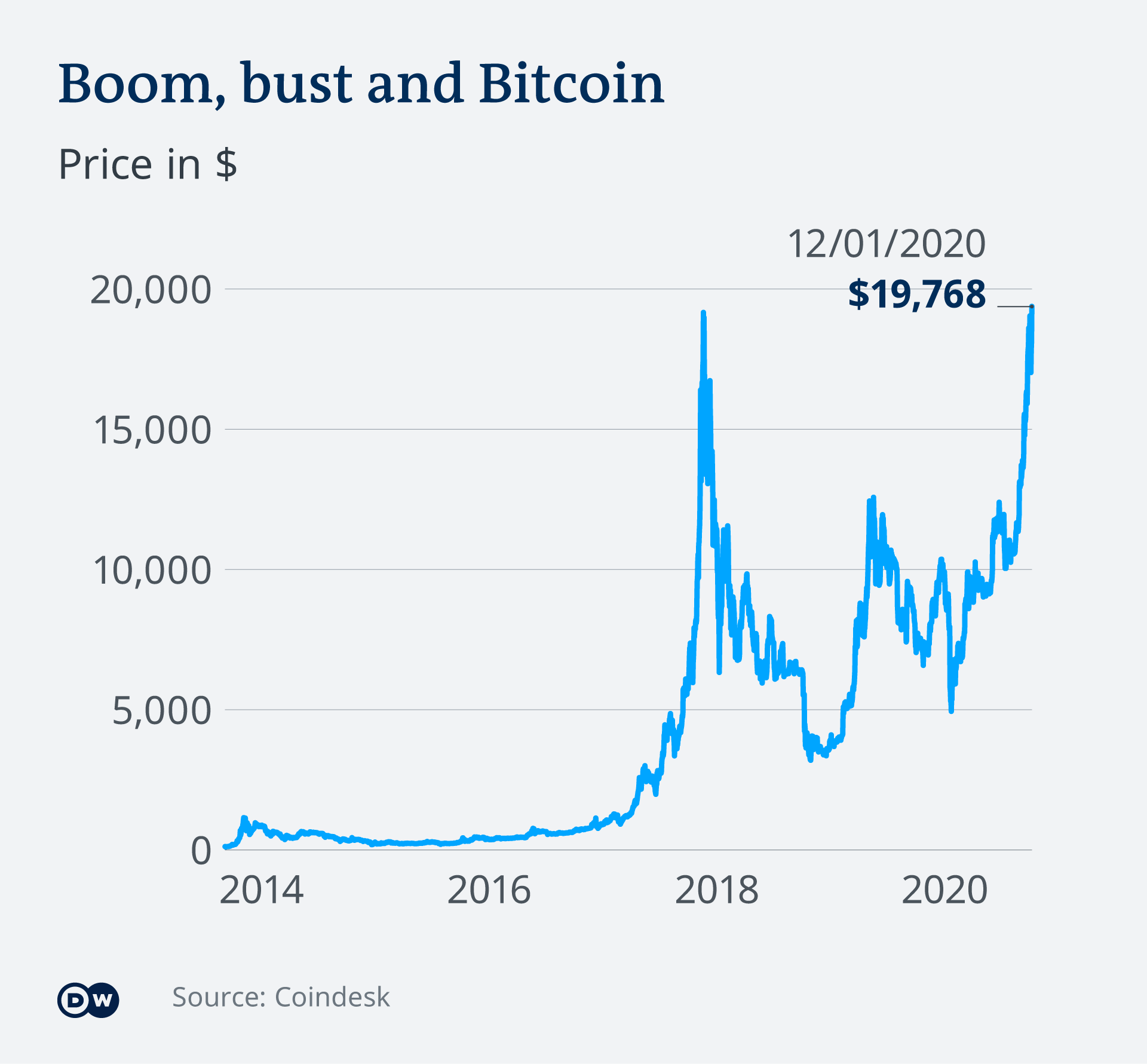
Following an increase in optimism and price after Donald Trump was re-elected in November 2024, Bitcoin breached $100,000 for the first time on Dec. 5, 2024, after years of arguments for and against its ability to do so by investors and analysts.

Top cryptocurrency

Cryptocurrency is a form of currency that exists solely in digital form. Cryptocurrency can be used to make near-instant overseas transfers and pay for purchases online without going through an intermediary, such as a bank, or it can be held as an investment.

Much like a lever can help lift heavier objects, margin trading in cryptocurrency involves the utilization of leverage to expand market involvement and potentially magnify gains or losses. This involves obtaining funds from the exchange to execute trades. However, it’s important to note that margin trading also entails heightened risks owing to the potential for greater losses.

cryptocurrency regulation

Cryptocurrency is a form of currency that exists solely in digital form. Cryptocurrency can be used to make near-instant overseas transfers and pay for purchases online without going through an intermediary, such as a bank, or it can be held as an investment.

Much like a lever can help lift heavier objects, margin trading in cryptocurrency involves the utilization of leverage to expand market involvement and potentially magnify gains or losses. This involves obtaining funds from the exchange to execute trades. However, it’s important to note that margin trading also entails heightened risks owing to the potential for greater losses.

BNB is the native token of Binance, one of the most popular cryptocurrency exchanges. The crypto was initially created on the ethereum network but now resides on Binance’s blockchain. It’s used for a range of transactions and applications. The token even gives users discounted fees on the Binance platform.

Like Tether, USD Coin (USDC) is a stablecoin, meaning U.S. dollars back it. It aims for a 1 USD to 1 USDC ratio. Ethereum powers USDC; you can use USD Coin to complete global transactions. As of Dec. 10, 2024, USDC is trading at $1.00.

Cryptocurrency regulation

GA Code § 7-1-680 defines money transmission as “engaging in the business of receiving money or monetary value for transmission” and virtual currency as “a digital representation of monetary value that does not have legal tender status.” GA Code § 7-1-681 states that “No person…shall engage in…money transmission without having first obtained a license authorizing such activity.” Based on the prior definitions, cryptocurrency transactions fall under this licensing requirement. The Department of Banking and Finance has issued Cease and Desist Orders against unlicensed cryptocurrency platforms, such as with CampBX in 2018. GA Code § 7-1-690 further allows the Department of Banking and Finance “to enact rules and regulations that apply solely to persons engaged in money transmission or the sale of payment instruments involving virtual currency.” GA Code § 53-13-2 defines a digital asset under the Revised Uniform Fiduciary Access to Digital Assets Act as “an electronic record in which an individual has a right or interest. Such term shall not include an underlying asset or liability unless the asset or liability is itself an electronic record.” The Act lays out rules for who can access a person’s digital assets, among other things.

In a 2021 Notice to Virginia Residents Regarding Virtual Currency, the Virginia Bureau of Financial Institutions stated that the Bureau “does not currently regulate virtual currencies; however, to the extent virtual currency transactions also involve the transfer of fiat currency… they may be regulated under .” On April 11, 2022, governor Glenn Youngkin signed into law HB 263, which allows Virginia banks to “provide customers with virtual currency custody services so long as the bank has adequate protocols in place to effectively manage risks and comply with applicable laws” and “provide virtual currency custody services in either a nonfiduciary or fiduciary capacity.”

New York’s Department of Financial Services established the BitLicense in 2015 under 23 NY Comp Codes Rules and Regs § 200 to regulate virtual currency businesses. 23 NY Comp Codes Rules and Regs § 200.2 defines Virtual Currency Business activity as “any one of the following types of activities…: (1) receiving Virtual Currency for Transmission or Transmitting Virtual Currency, except where the transaction is undertaken for non-financial purposes and does not involve the transfer of more than a nominal amount of Virtual Currency; (2) storing, holding, or maintaining custody or control of Virtual Currency on behalf of others; (3) buying and selling Virtual Currency as a customer business; (4) performing Exchange Services as a customer business; or (5) controlling, administering, or issuing a Virtual Currency.” 23 NY Comp Codes Rules and Regs § 200.3 states that “No Person shall, without a license obtained from the superintendent as provided in this Part, engage in any Virtual Currency Business Activity.” The rest of the statute lays out a series of requirements for licensees including capital requirements, AML programs, consumer protection, and many others. NY Banking L § 641 states that “No person shall engage in the business of…receiving money for transmission or transmitting the same, without a license.” Thus, businesses that transact in both fiat and cryptocurrency require both a money transmitter license and a BitLicense. This interpretation is confirmed by the Department of Financial Services’ BitLicense FAQs. The Department also states that “A business that is chartered under the New York Banking Law (for example, a New York State limited purpose trust company or a New York State bank) can engage in Virtual Currency Business Activity without a BitLicense if it has received the Superintendent’s approval to do so.” In 2020, New York’s Department of Financial Services proposed offering a conditional BitLicense for virtual currency companies to operate in a limited fashion by collaborating with authorized BitLicensees. This would allow early-stage companies to be supervised by the Department of Financial Services without going through the expensive process of getting a full BitLicense. In 2018, New York enacted AB 8783 to “establish the digital currency task force.” In 2019, SB 1194 increased the membership of the task force to 13 members. Signed into law by Governor Kathleen Hochul on April 9, 2022, AB 9009 “expands the definition of financial institution under the financial institution data match program,” which now includes virtual currency businesses. On June 8, 2022, New York’s Department of Financial Services released Guidance on the Issuance of U.S. Dollar-Backed Stablecoins, which adds requirements for “the redeemability of such stablecoins; the asset reserves that back such stablecoins…; and attestations concerning the backing by these Reserves.”

cryptocurrency

GA Code § 7-1-680 defines money transmission as “engaging in the business of receiving money or monetary value for transmission” and virtual currency as “a digital representation of monetary value that does not have legal tender status.” GA Code § 7-1-681 states that “No person…shall engage in…money transmission without having first obtained a license authorizing such activity.” Based on the prior definitions, cryptocurrency transactions fall under this licensing requirement. The Department of Banking and Finance has issued Cease and Desist Orders against unlicensed cryptocurrency platforms, such as with CampBX in 2018. GA Code § 7-1-690 further allows the Department of Banking and Finance “to enact rules and regulations that apply solely to persons engaged in money transmission or the sale of payment instruments involving virtual currency.” GA Code § 53-13-2 defines a digital asset under the Revised Uniform Fiduciary Access to Digital Assets Act as “an electronic record in which an individual has a right or interest. Such term shall not include an underlying asset or liability unless the asset or liability is itself an electronic record.” The Act lays out rules for who can access a person’s digital assets, among other things.

In a 2021 Notice to Virginia Residents Regarding Virtual Currency, the Virginia Bureau of Financial Institutions stated that the Bureau “does not currently regulate virtual currencies; however, to the extent virtual currency transactions also involve the transfer of fiat currency… they may be regulated under .” On April 11, 2022, governor Glenn Youngkin signed into law HB 263, which allows Virginia banks to “provide customers with virtual currency custody services so long as the bank has adequate protocols in place to effectively manage risks and comply with applicable laws” and “provide virtual currency custody services in either a nonfiduciary or fiduciary capacity.”

New York’s Department of Financial Services established the BitLicense in 2015 under 23 NY Comp Codes Rules and Regs § 200 to regulate virtual currency businesses. 23 NY Comp Codes Rules and Regs § 200.2 defines Virtual Currency Business activity as “any one of the following types of activities…: (1) receiving Virtual Currency for Transmission or Transmitting Virtual Currency, except where the transaction is undertaken for non-financial purposes and does not involve the transfer of more than a nominal amount of Virtual Currency; (2) storing, holding, or maintaining custody or control of Virtual Currency on behalf of others; (3) buying and selling Virtual Currency as a customer business; (4) performing Exchange Services as a customer business; or (5) controlling, administering, or issuing a Virtual Currency.” 23 NY Comp Codes Rules and Regs § 200.3 states that “No Person shall, without a license obtained from the superintendent as provided in this Part, engage in any Virtual Currency Business Activity.” The rest of the statute lays out a series of requirements for licensees including capital requirements, AML programs, consumer protection, and many others. NY Banking L § 641 states that “No person shall engage in the business of…receiving money for transmission or transmitting the same, without a license.” Thus, businesses that transact in both fiat and cryptocurrency require both a money transmitter license and a BitLicense. This interpretation is confirmed by the Department of Financial Services’ BitLicense FAQs. The Department also states that “A business that is chartered under the New York Banking Law (for example, a New York State limited purpose trust company or a New York State bank) can engage in Virtual Currency Business Activity without a BitLicense if it has received the Superintendent’s approval to do so.” In 2020, New York’s Department of Financial Services proposed offering a conditional BitLicense for virtual currency companies to operate in a limited fashion by collaborating with authorized BitLicensees. This would allow early-stage companies to be supervised by the Department of Financial Services without going through the expensive process of getting a full BitLicense. In 2018, New York enacted AB 8783 to “establish the digital currency task force.” In 2019, SB 1194 increased the membership of the task force to 13 members. Signed into law by Governor Kathleen Hochul on April 9, 2022, AB 9009 “expands the definition of financial institution under the financial institution data match program,” which now includes virtual currency businesses. On June 8, 2022, New York’s Department of Financial Services released Guidance on the Issuance of U.S. Dollar-Backed Stablecoins, which adds requirements for “the redeemability of such stablecoins; the asset reserves that back such stablecoins…; and attestations concerning the backing by these Reserves.”

cryptocurrency

Cryptocurrency

Here at CoinMarketCap, we work very hard to ensure that all the relevant and up-to-date information about cryptocurrencies, coins and tokens can be located in one easily discoverable place https://wishmanhero.com/. From the very first day, the goal was for the site to be the number one location online for crypto market data, and we work hard to empower our users with our unbiased and accurate information.

Somewhat later to the crypto scene, Cardano (ADA) is notable for its early embrace of proof-of-stake validation. This method expedites transaction time and decreases energy usage and environmental impact by removing the competitive, problem-solving aspect of transaction verification in platforms like bitcoin. Cardano also works like Ethereum to enable smart contracts and decentralised applications, which ADA, its native coin, powers.

To the extent any recommendations or statements of opinion or fact made in a story may constitute financial advice, they constitute general information and not personal financial advice in any form. As such, any recommendations or statements do not take into account the financial circumstances, investment objectives, tax implications, or any specific requirements of readers.

How much it costs to buy cryptocurrency depends on a number of factors, including which crypto you are buying. Many small altcoins trade for a fraction of a cent, while a single bitcoin will cost you tens of thousands of dollars. However, many brokerages and exchanges now allow fractional trading, offering investors the option to buy a portion of a cryptocurrency.

bitcoin cryptocurrency

Bitcoin cryptocurrency

On Jan. 3, 2009, the first Bitcoin block was mined. Called Block 0, it is also known as the genesis block and contains the text: “The Times 03/Jan/2009 Chancellor on brink of second bailout for banks,” perhaps proof that the block was mined on or after that date.

Just two months later, on January 3, 2009, Nakamoto mined the first block on the Bitcoin network, known as the genesis block, thus launching the world’s first cryptocurrency. Bitcoin price was $0 when first introduced, and most Bitcoins were obtained via mining, which only required moderately powerful devices (e.g. PCs) and mining software. The first known Bitcoin commercial transaction occurred on May 22, 2010, when programmer Laszlo Hanyecz traded 10,000 Bitcoins for two pizzas. At Bitcoin price today in mid-September 2021, those pizzas would be worth an astonishing $478 million. This event is now known as “Bitcoin Pizza Day.” In July 2010, Bitcoin first started trading, with the Bitcoin price ranging from $0.0008 to $0.08 at that time.

Bitcoin is becoming more political by the day, particularly after El Salvador began accepting the currency as legal tender. The country’s president, Nayib Bukele, announced and implemented the decision almost unilaterally, dismissing criticism from his citizens, the Bank of England, the IMF, Vitalik Buterin and many others. Since the Bitcoin legal tender law was passed in September 2021, Bukele has also announced plans to build Bitcoin City, a city fully based on mining Bitcoin with geothermal energy from volcanoes.

cryptocurrency

On Jan. 3, 2009, the first Bitcoin block was mined. Called Block 0, it is also known as the genesis block and contains the text: “The Times 03/Jan/2009 Chancellor on brink of second bailout for banks,” perhaps proof that the block was mined on or after that date.

Just two months later, on January 3, 2009, Nakamoto mined the first block on the Bitcoin network, known as the genesis block, thus launching the world’s first cryptocurrency. Bitcoin price was $0 when first introduced, and most Bitcoins were obtained via mining, which only required moderately powerful devices (e.g. PCs) and mining software. The first known Bitcoin commercial transaction occurred on May 22, 2010, when programmer Laszlo Hanyecz traded 10,000 Bitcoins for two pizzas. At Bitcoin price today in mid-September 2021, those pizzas would be worth an astonishing $478 million. This event is now known as “Bitcoin Pizza Day.” In July 2010, Bitcoin first started trading, with the Bitcoin price ranging from $0.0008 to $0.08 at that time.

Cryptocurrency

There is stiff competition for these rewards, so many users try to submit blocks, but only one can be selected for each new block of transactions. To decide who gets the reward, Bitcoin requires users to solve a difficult puzzle, which uses a huge amount of energy and computing power. The completion of this puzzle is the “work” in proof of work.

Regulators have increasingly signaled that cryptocurrencies should be regulated similarly to other securities, such as stocks and bonds. However, with the June 2024 Loper Bright Enterprises v. Raimondo Supreme Court ruling, that may change — Congress may have to clearly define crypto regulation through law making rather than allowing the SEC to enforce rules based on its interpretation. That could have major implications for the asset class in the future.

Many, or all, of the products featured on this page are from our advertising partners who compensate us when you take certain actions on our website or click to take an action on their website. However, this does not influence our evaluations. Our opinions are our own. Here is a list of our partners and here’s how we make money.

Thoughtfully selecting your cryptocurrency, however, is no guarantee of success in such a volatile space. Sometimes, an issue in the deeply interconnected crypto industry can spill out and have broad implications on asset values.