
Shiba inu cryptocurrency
Yes, the US government does track cryptocurrency, as the IRS has requested crypto exchanges and platforms to report tax forms such as 1099-B and 1099-K. Additionally, some exchanges have received subpoenas ordering them to reveal certain user accounts https://aussie-play.org/.
As the discussion around the SEC-CFTC merger unfolds, industry stakeholders will need to engage with policymakers to ensure that any new regulatory framework supports both innovation and consumer protection.
Money transmitter licensees who deal in virtual currency may have to obtain an increased surety bond. N.C.G.S. § 53-208.47(d). Investments in virtual currency by licensees may be verified at any time by the Commissioner of Banks. N.C.G.S. § 53-208.48(c).
Georgia’s money transmission laws define “money transmission” as receiving or transmitting “monetary value,” and “virtual currency” is specifically defined as “a digital representation of monetary value.” O.C.G.A. §7-1-680(13), (26). Therefore, a license is required under O.C.G.A. §7-1-681, and Georgia regulators have the power to enact virtual currency-specific rules. O.C.G.A. §7-1-690.
Cryptocurrency
On 13 September 2018, Homero Josh Garza was sentenced to 21 months of imprisonment, followed by three years of supervised release. Garza had founded the cryptocurrency startups GAW Miners and ZenMiner in 2014, acknowledged in a plea agreement that the companies were part of a pyramid scheme, and pleaded guilty to wire fraud in 2015. The SEC separately brought a civil enforcement action in the US against Garza, who was eventually ordered to pay a judgment of $9.1 million plus $700,000 in interest. The SEC’s complaint stated that Garza, through his companies, had fraudulently sold “investment contracts representing shares in the profits they claimed would be generated” from mining.
Cryptocurrency is produced by an entire cryptocurrency system collectively, at a rate that is defined when the system is created and that is publicly stated. In centralized banking and economic systems such as the US Federal Reserve System, corporate boards or governments control the supply of currency. In the case of cryptocurrency, companies or governments cannot produce new units and have not so far provided backing for other firms, banks, or corporate entities that hold asset value measured in it. The underlying technical system upon which cryptocurrencies are based was created by Satoshi Nakamoto.
Proof-of-work cryptocurrencies, such as bitcoin, offer block rewards incentives for miners. There has been an implicit belief that whether miners are paid by block rewards or transaction fees does not affect the security of the blockchain, but a study suggests that this may not be the case under certain circumstances.
On 13 September 2018, Homero Josh Garza was sentenced to 21 months of imprisonment, followed by three years of supervised release. Garza had founded the cryptocurrency startups GAW Miners and ZenMiner in 2014, acknowledged in a plea agreement that the companies were part of a pyramid scheme, and pleaded guilty to wire fraud in 2015. The SEC separately brought a civil enforcement action in the US against Garza, who was eventually ordered to pay a judgment of $9.1 million plus $700,000 in interest. The SEC’s complaint stated that Garza, through his companies, had fraudulently sold “investment contracts representing shares in the profits they claimed would be generated” from mining.
Cryptocurrency is produced by an entire cryptocurrency system collectively, at a rate that is defined when the system is created and that is publicly stated. In centralized banking and economic systems such as the US Federal Reserve System, corporate boards or governments control the supply of currency. In the case of cryptocurrency, companies or governments cannot produce new units and have not so far provided backing for other firms, banks, or corporate entities that hold asset value measured in it. The underlying technical system upon which cryptocurrencies are based was created by Satoshi Nakamoto.
Proof-of-work cryptocurrencies, such as bitcoin, offer block rewards incentives for miners. There has been an implicit belief that whether miners are paid by block rewards or transaction fees does not affect the security of the blockchain, but a study suggests that this may not be the case under certain circumstances.
Cryptocurrency market
With so many crypto projects and products available, it can be hard to decide which ones are the best fit for your specific needs. Which is why we’ve created an extensive section specifically for reviewing and ranking projects in the market. From dApps and staking solutions to Telegram trading bots and exchanges, we provide in-depth reviews and curated top lists to help you confidently choose the right products in the crypto space.
Wir erhalten aktualisierte Kryptowährungs-Preise direkt von verschiedenen Börsen basierend auf dem jeweiligen Währungspaar. Wir konvertieren die Zahlen dann in USD. Eine detaillierte Erläuterung findest Du hier.
Hier bei CoinMarketCap arbeiten wir angestrengt daran, sicherzustellen, dass sämtliche relevanten und topaktuellen Informationen bezüglich Kryptowährungen, Coins und Tokens ganz einfach auf einen Blick einzusehen sind. Vom allerersten Tag an war es das Ziel der Seite, die “Nummer 1” der Online-Locations für Kryptomarkt-Daten zu sein. Wir bemühen uns sehr, unseren Usern durch unabhängige und korrekte Informationen die Möglichkeit zu geben, befähigte Entscheidungen zu treffen.
What is cryptocurrency
In addition, because the IRS has labeled Bitcoin an asset and not a currency, every transaction with Bitcoin has the potential to create a taxable capital gain, meaning you must report it on your tax return. If you spend bitcoins at a price higher than you purchased them, you’ll owe tax.
Cryptocurrency networks display a lack of regulation that has been criticized as enabling criminals who seek to evade taxes and launder money. Money laundering issues are also present in regular bank transfers, however with bank-to-bank wire transfers for instance, the account holder must at least provide a proven identity.
Transaction fees (sometimes also referred to as miner fees or gas fees) for cryptocurrency depend mainly on the supply of network capacity at the time, versus the demand from the currency holder for a faster transaction. The ability for the holder to be allowed to set the fee manually often depends on the wallet software used, and central exchanges for cryptocurrency (CEX) usually do not allow the customer to set a custom transaction fee for the transaction. Their wallet software, such as Coinbase Wallet, however, might support adjusting the fee.
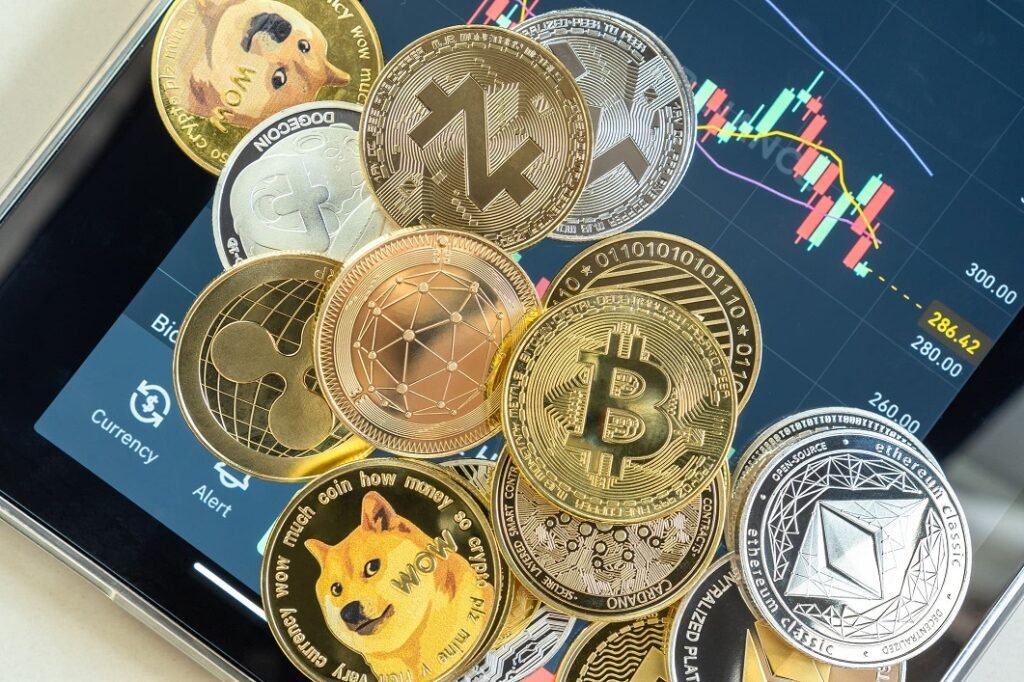
Memecoins are a category of cryptocurrencies that originated from Internet memes or jokes. The most notable example is Dogecoin, a memecoin featuring the Shiba Inu dog from the Doge meme. Memecoins are known for extreme volatility; for example, the record-high value for a Dogecoin was 73 cents, but that had plunged to 13 cents by mid-2024. Scams are prolific among memecoins.
A cryptocurrency wallet is a means of storing the public and private “keys” (address) or seed, which can be used to receive or spend the cryptocurrency. With the private key, it is possible to write in the public ledger, effectively spending the associated cryptocurrency. With the public key, it is possible for others to send currency to the wallet.