
Cryptocurrency
Though they claim to be an anonymous form of transaction, cryptocurrencies are pseudonymous. They leave a digital trail that agencies like the Federal Bureau of Investigation (FBI) can follow https://casino-us-casino.com/. This opens up the possibility for governments, authorities, and others to track financial transactions.
The market capitalization of a cryptocurrency is calculated by multiplying the price by the number of coins in circulation. The total cryptocurrency market cap has historically been dominated by bitcoin accounting for at least 50% of the market cap value where altcoins have increased and decreased in market cap value in relation to bitcoin. Bitcoin’s value is largely determined by speculation among other technological limiting factors known as blockchain rewards coded into the architecture technology of bitcoin itself. The cryptocurrency market cap follows a trend known as the “halving”, which is when the block rewards received from bitcoin are halved due to technological mandated limited factors instilled into bitcoin which in turn limits the supply of bitcoin. As the date reaches near of a halving (twice thus far historically) the cryptocurrency market cap increases, followed by a downtrend.
Related Links Are you ready to learn more? Visit our glossary and crypto learning center. Are you interested in the scope of crypto assets? Investigate our list of cryptocurrency categories. Are you interested in knowing which the hottest dex pairs are currently?
On 11 November 2022, FTX Trading Ltd., a cryptocurrency exchange, which also operated a crypto hedge fund, and had been valued at $18 billion, filed for bankruptcy. The financial impact of the collapse extended beyond the immediate FTX customer base, as reported, while, at a Reuters conference, financial industry executives said that “regulators must step in to protect crypto investors.” Technology analyst Avivah Litan commented on the cryptocurrency ecosystem that “everything…needs to improve dramatically in terms of user experience, controls, safety, customer service.”

Cryptocurrency regulation
For example, Maryland’s Office of the Commissioner of Financial Regulation considers the transmission of virtual currency to be subject to its money transmission regulations. In contrast, Texas does not require a license for the exchange or transfer of most virtual currencies, but trading in stablecoins or using a third-party exchanger does require a license as money transmission. Meanwhile, Hawaii has established the Digital Currency Innovation Lab to provide digital currency businesses with permission to determine the necessary licensing. These examples demonstrate the wide range of state-level approaches to cryptocurrency regulation in the United States.
The first regulated funds in the U.S. based on crypto were futures-based bitcoin and ether (ETH) ETFs. They invest in bitcoin or ETH futures contracts traded on U.S. exchanges. Futures-based ETFs provide investors with indirect exposure to cryptocurrency price moves without the need to directly own or store the underlying assets. However, futures-based ETFs may not perfectly track the spot price of the cryptocurrency because of rolling costs and other factors.
Switzerland’s government has indicated that it will continue to work towards a regulatory environment that is friendly to cryptocurrencies. In 2016, the town of Zug, a prominent global cryptocurrency hub, introduced Bitcoin as a way of paying city fees while in January 2018, Swiss Economics Minister Johann Schneider-Ammann stated that he was aiming to make Switzerland “the crypto-nation”. Similarly, the Swiss Secretary for International Finance, Jörg Gasser, has emphasized the need to promote cryptocurrencies while upholding existing financial standards.
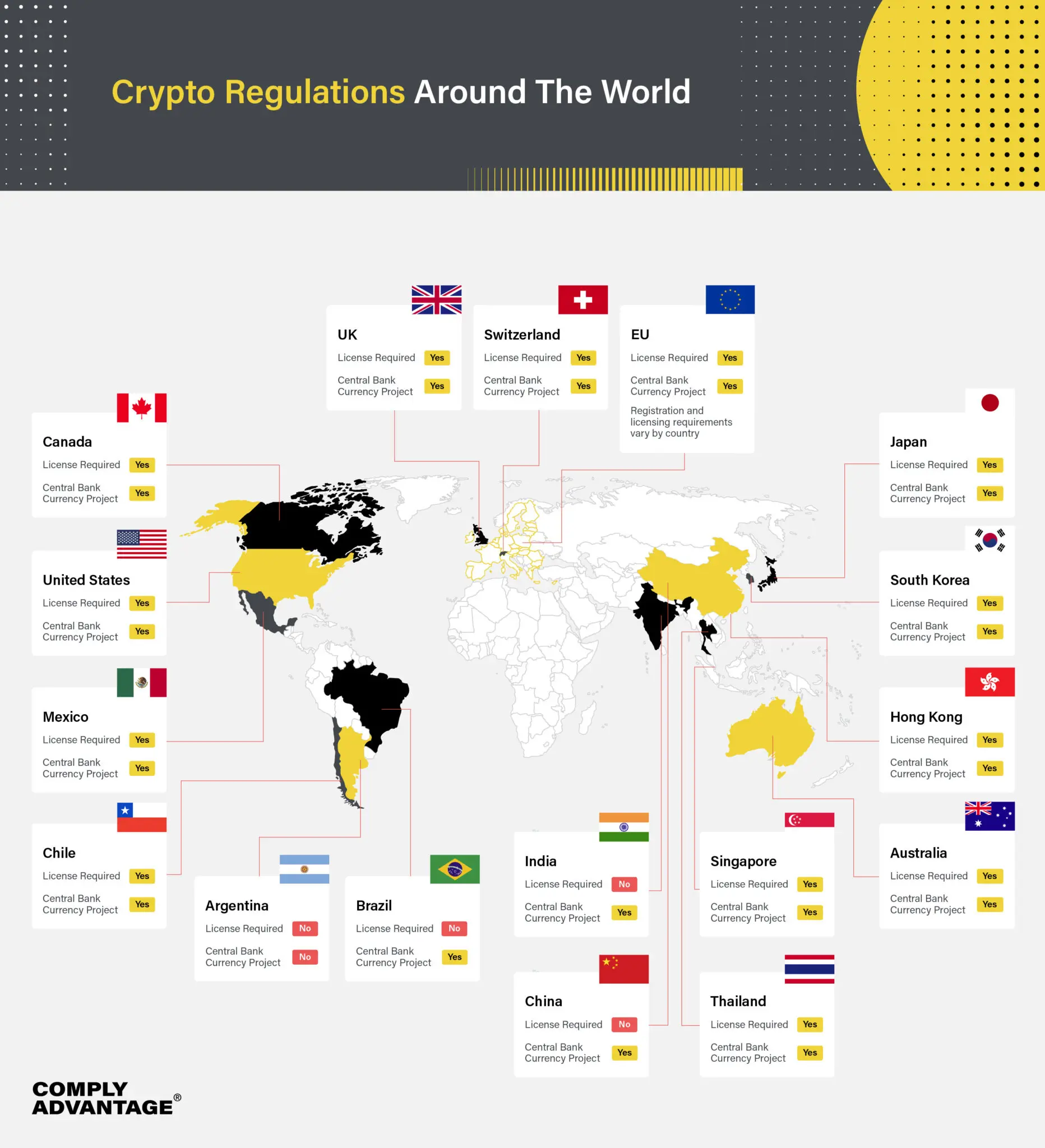
For example, Maryland’s Office of the Commissioner of Financial Regulation considers the transmission of virtual currency to be subject to its money transmission regulations. In contrast, Texas does not require a license for the exchange or transfer of most virtual currencies, but trading in stablecoins or using a third-party exchanger does require a license as money transmission. Meanwhile, Hawaii has established the Digital Currency Innovation Lab to provide digital currency businesses with permission to determine the necessary licensing. These examples demonstrate the wide range of state-level approaches to cryptocurrency regulation in the United States.
The first regulated funds in the U.S. based on crypto were futures-based bitcoin and ether (ETH) ETFs. They invest in bitcoin or ETH futures contracts traded on U.S. exchanges. Futures-based ETFs provide investors with indirect exposure to cryptocurrency price moves without the need to directly own or store the underlying assets. However, futures-based ETFs may not perfectly track the spot price of the cryptocurrency because of rolling costs and other factors.
Bitcoin cryptocurrency
Bitcoin had a price of $7,167.52 on Dec. 31, 2019, and a year later, it had appreciated more than 300% to $28,984.98. It continued to surge in the first half of 2021, trading at a record high of $69,000 in November 2021. It then fell over the next few months to hover around $40,000 and rose with increasing speed in 2024 to more than $100,000.
Governments have been relatively slow to react to the advent of cryptocurrency, but many have now woken up and are beginning to study how to regulate it. Some countries, such as China, have banned it outright, while others are considering doing so. Still others, such as the United States, are examining how they might regulate cryptocurrency more effectively.
The difficulty of generating a block is deterministically adjusted based on the mining power on the network by changing the difficulty target, which is recalibrated every 2,016 blocks (approximately two weeks) to maintain an average time of ten minutes between new blocks. The process requires significant computational power and specialized hardware. : ch. 8
Research produced by the University of Cambridge estimated that in 2017, there were 2.9 to 5.8 million unique users using a cryptocurrency wallet, most of them using bitcoin. In August 2017, the SegWit software upgrade was activated. Segwit was intended to support the Lightning Network as well as improve scalability. SegWit opponents, who supported larger blocks as a scalability solution, forked to create Bitcoin Cash, one of many forks of bitcoin.